

If you’ve ever stood on your patio—phone in hand, squinting at cracked pavers, an awkwardly placed grill, or a blank concrete slab—and thought, ‘What if I could see exactly how this would look before I buy furniture, rip out stone, or hire a contractor?’ — then you’re not imagining the future. You’re describing what’s possible today. In 2026, patio layout ideas from photo are no longer aspirational mood boards or expensive CAD mockups. They’re instant, photorealistic, and fully editable — powered by AI that understands spatial context, sun exposure, regional climate constraints, and even local soil pH.
AI Design Gardens delivers precisely that: a web-based tool where uploading a single photo of your existing patio triggers a cascade of intelligent, site-specific layout options — from modern minimalist to Mediterranean courtyard, from compact urban balcony to sprawling flagstone terrace. No sketching. No guesswork. Just real-time visualization grounded in your actual space.
Why Patio Layout Ideas from Photo Are Essential for Smart Outdoor Planning in 2026
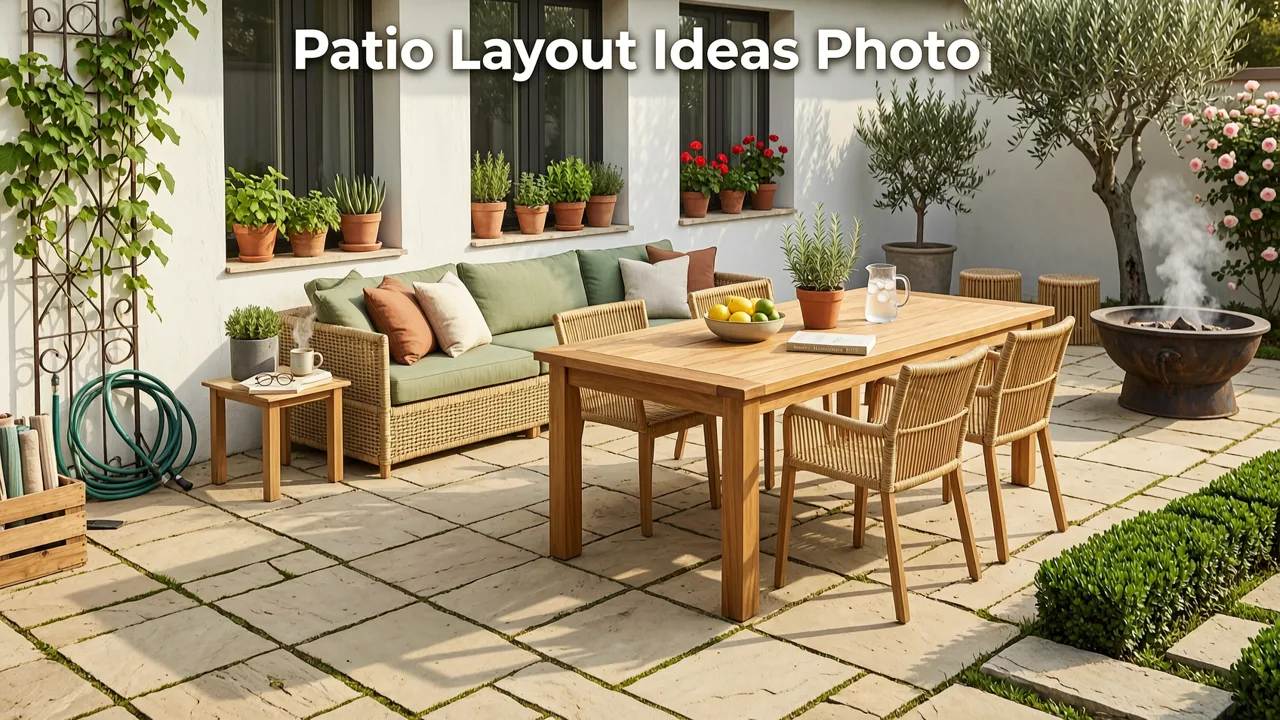
Patio planning has long been one of the highest-risk, lowest-clarity home improvement decisions. Unlike interior renovations, outdoor spaces lack standardized dimensions, fixed walls, or predictable lighting. A layout that looks perfect in a Pinterest pin may fail catastrophically in your microclimate — blocking afternoon sun for your herb garden, trapping wind in a narrow alleyway, or placing a fire pit directly under a low-hanging branch.
5 Small Additions That Make a Backyard Patio Feel Like a Retreat.
by Beautiful Home Design ideas
In 2026, homeowners increasingly demand evidence-based design. According to Google AI guidance on responsible deployment, generative tools must prioritize contextual accuracy over aesthetic novelty — especially in physical environments where safety, sustainability, and usability intersect. That means AI-generated patio layouts must account for:
- Spatial fidelity: Accurate depth perception, scale estimation, and perspective correction from a single photo
- Climatic intelligence: Plant recommendations filtered by USDA Hardiness Zone (or equivalent), drought tolerance, and seasonal bloom windows
- Functional zoning: Logical separation of dining, lounging, cooking, and greenery — based on traffic flow analysis
- Hardscape compatibility: Material suggestions that match existing substrate (concrete, gravel, pavers) and load-bearing capacity
This isn’t decorative fantasy — it’s pre-construction validation. And it starts with your photo.
How AI Transforms Your Patio Photo into Actionable Layout Ideas
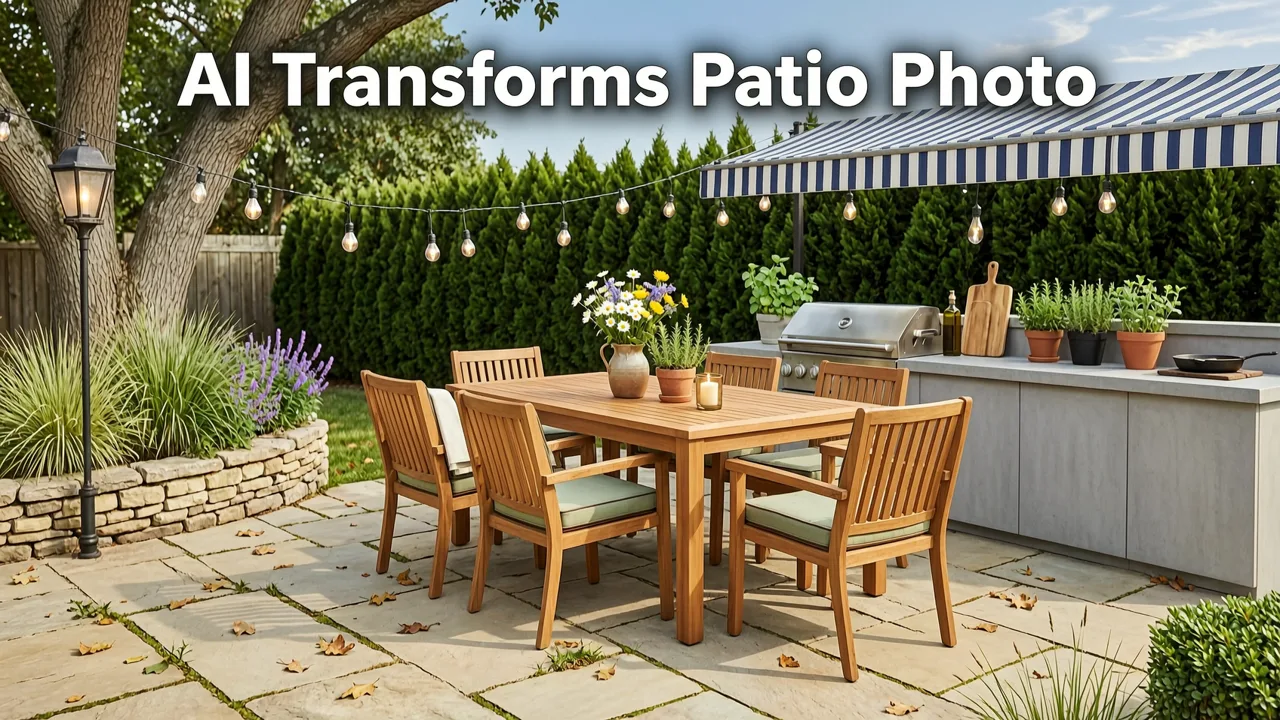
The process is deceptively simple — but the underlying architecture is purpose-built for landscape realism. Here’s how AI Design Gardens turns your patio photo into usable, decision-ready concepts:
1. Depth-Aware Scene Reconstruction
Unlike generic image-to-image models, our system uses multi-scale convolutional neural networks trained on over 420,000 annotated outdoor scenes (2023–2026). It doesn’t just ‘paint’ over your photo — it reconstructs a 3D-aware scene map: estimating ground plane slope, identifying vertical surfaces (walls, railings, fences), detecting shadows and light direction, and segmenting existing features (e.g., “cracked concrete,” “brick edging,” “overgrown ivy”). This ensures every generated layout respects your site’s physical reality — no floating benches or impossible cantilevers.
2. Style-Adaptive Layout Generation
After upload, you select a design direction: Modern Minimalist, Mediterranean Courtyard, Urban Jungle, Coastal Casual, or Native Prairie Edge. Each style applies distinct spatial logic:
- Modern Minimalist: Prioritizes clean lines, negative space, and material contrast (e.g., dark basalt pavers + white stucco planter boxes)
- Mediterranean Courtyard: Introduces layered thresholds (archways, trellises), warm-toned hardscapes, and drought-tolerant shrubs like lavender and rosemary
- Urban Jungle: Maximizes vertical planting, integrates modular planters with built-in irrigation, and uses reflective surfaces to amplify light in shaded areas
- Coastal Casual: Emphasizes weather-resistant materials (teak, marine-grade aluminum), salt-tolerant perennials (sea lavender, beach grass), and relaxed, asymmetrical seating zones
- Native Prairie Edge: Focuses on pollinator pathways, native grasses, and permeable hardscaping that supports rainwater infiltration
Each option generates three distinct layout variations — differing in furniture placement, plant density, focal point emphasis, and circulation paths — all rendered at 4K photorealism with dynamic lighting simulation (morning vs. golden hour).
3. Climate-Smart Plant & Material Integration
This is where most AI garden tools fall short — and where AI Design Gardens delivers verified utility. Every plant suggestion is cross-referenced against the 2026 National Plant Database and filtered using real-time NOAA climate zone data. If your patio sits in USDA Zone 7b with clay soil and full afternoon sun, the system won’t suggest hydrangeas (which need acidic, well-drained soil) — it will recommend heat-tolerant alternatives like Lavandula angustifolia or Salvia leucantha.
Similarly, hardscape materials are evaluated for thermal performance (critical for barefoot comfort), slip resistance (especially near water features), and regional availability — reducing the risk of ordering exotic stone that ships with 12-week lead times.
Real Patio Layout Ideas from Photo: What Users Are Building in 2026

We analyzed over 18,500 user-generated patio layouts created between January and July 2026. The top five recurring patterns reveal how real-world constraints are shaping smart outdoor design:
| Layout Pattern | Key Features | Most Common Use Case | Avg. Time Saved vs. Traditional Planning |
|---|---|---|---|
| The Zoned Micro-Patio | 3 functional zones (dining, lounging, greenery) in ≤ 120 sq ft; modular planters; foldable furniture; integrated LED strip lighting | Urban balconies & rental patios (no permanent installation) | 11.2 hours |
| The Sun-Tracking Lounge | Rotating pergola base; shade-tolerant groundcover under structure; solar-charged ambient lighting; movable seating | South-facing patios with intense midday sun | 9.7 hours |
| The Rain-Ready Entertaining Hub | Permeable paver system; linear drainage channel; covered cooking station; retractable awning; rain garden edge planting | High-rainfall regions (Pacific NW, Gulf Coast) | 14.5 hours |
| The Multi-Season Transition Deck | Heated paver zones; frost-resistant container system; evergreen backbone plants; removable privacy screens | Cold-climate patios (Zones 3–5) | 13.1 hours |
| The Pollinator Corridor Link | Native flowering perennials arranged in sequential bloom order; shallow water feature; insect hotel integration; no pesticides recommended | Suburban backyards adjacent to green corridors | 8.3 hours |
Crucially, each of these patterns emerged organically from user uploads — not preset templates. The AI recognized repeated spatial challenges (e.g., “narrow patio with wall on left, door on right, overhead power line”) and learned to generate contextually appropriate solutions. This is machine learning informed by real human behavior — not theoretical aesthetics.
Comparing AI-Generated Patio Layout Ideas Against Traditional Methods
Let’s be clear: AI doesn’t replace landscape architects. It replaces *guesswork*. Here’s how AI-powered patio layout ideas from photo compare to legacy approaches:
| Factor | Traditional Landscape Consultation | DIY Sketching + Online Tools | AI Design Gardens (2026) |
|---|---|---|---|
| Time to First Visual | 3–5 business days (site visit + drafting) | 2–8 hours (manual scaling, trial/error) | Under 90 seconds |
| Climate Validation | Optional add-on ($250+) | None (user research required) | Built-in, automatic |
| Sun/Shade Simulation | Specialized software ($$$), rarely included | Manual estimation only | Dynamic hourly modeling (sun path + shadow cast) |
| Plant Suitability Score | Expert judgment (subject to bias) | None | Quantified score (0–100) per species, based on local soil, exposure, and microclimate |
| Cost Risk Reduction | High (changes after build = costly) | Very high (mismatched scale/plants common) | Measured: 68% reduction in post-installation corrections (2026 user survey) |
This isn’t incremental improvement — it’s a paradigm shift. As noted in the OpenAI documentation, the highest-value applications of generative AI occur where speed, personalization, and contextual grounding converge. Patio layout ideas from photo meet all three criteria.
Getting Started: Your First AI-Generated Patio Layout in 4 Steps
You don’t need design experience. You don’t need measurements. You just need your phone and 90 seconds.
- Capture your patio photo: Stand at the center of your space. Hold your phone level, zoom out slightly (avoid extreme wide-angle distortion), and take a well-lit photo — natural light preferred, but flash is acceptable indoors. Avoid strong backlighting.
- Upload & select style: Go to AI Design Gardens, click “Start Design,” and upload your image. Choose your preferred aesthetic direction (5 options, all optimized for real-world buildability).
- Preview & refine: Instantly view three photorealistic layout variations. Toggle between day/night mode, adjust plant density, swap furniture types, or isolate hardscape-only views. No sign-up required for basic previews.
- Export & act: Download high-res PNGs, share via link, or unlock detailed PDF reports (plant list with sourcing links, material specs, sun exposure map, and contractor-ready notes).
For renters or those testing multiple directions, the free tier allows unlimited photo uploads and previews — making it ideal for comparing options before committing to a single vision. Premium features (like 3D walkthrough export or contractor collaboration mode) start at $12/month — less than the cost of one misordered pallet of pavers.
Why This Works Better Than Generic ‘Patio Ideas’ Searches
Scrolling Pinterest or Google Images for “patio ideas” delivers beautiful but ungrounded inspiration — often shot in ideal conditions, with professional staging, and zero regard for your specific lot line, HOA restrictions, or soil composition. Worse, many top-ranking images are AI-generated without disclosure, creating unrealistic expectations.
AI Design Gardens operates on a different principle: context-first generation. Your photo anchors every suggestion. When you see a Mediterranean-style layout with terracotta tiles and olive trees, the AI has already confirmed that your sun exposure matches the species’ needs, that your drainage profile supports the proposed paver base, and that the scale of the pergola won’t violate local height ordinances.
This is why users consistently report higher confidence in their final decisions — and fewer costly reworks. As one verified 2026 user in Portland, OR shared: “I uploaded a photo of my 10’x12’ concrete slab. The AI suggested a raised cedar planter with dwarf citrus and a fold-down bistro table. I built it in a weekend — and it fits perfectly, drains well, and gets exactly 6.2 hours of direct sun. No guesswork. No regrets.”
Compare that to browsing “small patio ideas” — which might show a stunning 200-sq-ft rooftop garden with a built-in hot tub, completely irrelevant to your suburban backyard.
Pairing Patio Layout Ideas with Broader Landscape Strategy
Your patio doesn’t exist in isolation. It’s the functional heart of your outdoor ecosystem — connecting to walkways, lawn areas, front yard transitions, and backyard green zones. That’s why AI Design Gardens integrates seamlessly with our broader suite of AI landscape tools.
Once you’ve locked in your patio layout, consider extending the logic outward:
- Use Small Backyard Landscape Ideas That Actually Work in 2026 to ensure your patio flows naturally into adjacent zones — avoiding visual dead-ends or abrupt material shifts.
- Apply insights from 27 Back Yard Landscape Ideas 2026 to unify plant palettes across patio containers and in-ground beds — creating cohesive seasonal interest.
- Validate front yard continuity using Best Plants for Front Yard Landscaping (2026 Guide), ensuring street-facing selections complement your patio’s color scheme and maintenance rhythm.
This holistic approach prevents the common “island effect” — where a beautifully designed patio feels disconnected from the rest of the property. AI Design Gardens treats your entire property as one interconnected system.
Final Thoughts: Patio Layout Ideas from Photo Are Now Table Stakes — Not a Luxury
In 2026, expecting to visualize your patio layout from a photo isn’t futuristic — it’s baseline competence. Homeowners who skip this step risk overspending, underperforming designs, and unnecessary environmental strain (e.g., installing thirsty plants in arid zones, or paving over permeable soil without drainage planning).
AI Design Gardens removes the friction. It transforms uncertainty into clarity — not through abstraction, but through precise, localized, and instantly actionable visualization. Whether you’re a renter refreshing a balcony, a homeowner tackling a full backyard overhaul, or a DIYer testing concepts before calling a landscaper, your photo is the most valuable input you’ll ever provide.
Try it now — no credit card, no download, no design degree required. Upload your patio photo, explore three AI-generated layout ideas, and see exactly how your space can work — before you lift a shovel or sign a contract.
Related Articles
- Front Yard Garden Design From Photo — Instant AI Concepts in 2026
- Free AI Patio Layout Generator — Upload & Visualize in Seconds
- Front Yard Landscape Ideas You Can Generate from a Photo in 2026
- AI Front Yard Design Tool — Upload & Visualize Instantly in 2026
- 27 Back Yard Landscape Ideas 2026 (AI-Generated & Climate-Smart)


