

If you’ve ever stood at your curb staring at a blank, underwhelming, or overgrown front yard—and wondered, ‘What would this actually look like with native shrubs, a clean hardscape path, and seasonal color?’—you’re not lacking vision. You’re lacking an AI front yard design tool built for real-world constraints: your soil type, local climate, HOA rules, rental restrictions, and actual photo of your space.
In 2026, the leading solution isn’t a desktop CAD program or a $300 consultation—it’s AI Garden, a web-based AI front yard design tool that transforms your smartphone photo into three photorealistic, style-matched front yard concepts in under 90 seconds. No sketching. No guesswork. No costly planting mistakes before ground is broken.
Why This Is the Best AI Front Yard Design Tool in 2026
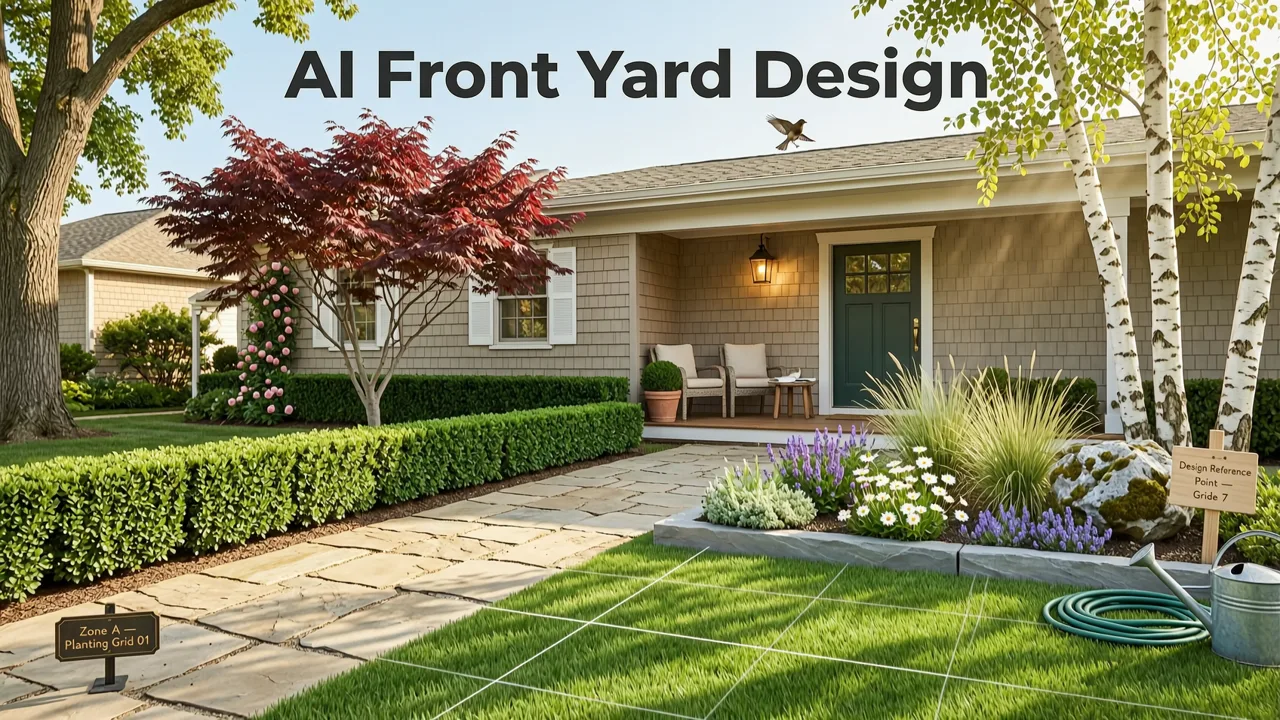
Not all AI landscape tools are built equal—and many still treat front yards as generic ‘green rectangles’. In 2026, the most effective AI front yard design tool must do four things exceptionally well:
Can AI design my yard for free? 🪴 Tips for do-it-yourselfers (from a landscape designer)
by Garden Project Academy
- Understand spatial context: Recognise property lines, driveways, sidewalks, utility boxes, and existing trees—not just grass and sky.
- Respect regional realism: Recommend plants that survive your USDA Hardiness Zone (or RHS hardiness rating), match local water restrictions, and align with municipal codes (e.g., no tall hedges near intersections).
- Support decision-making—not just decoration: Let you compare drought-tolerant vs. pollinator-rich layouts side-by-side, simulate seasonal change, and toggle features like lighting, fencing, or permeable pavers.
- Work for renters and homeowners alike: Offer non-permanent options (raised beds, modular planters, gravel overlays) and flag HOA-compliant choices upfront.
AI Garden does all four—and does them natively in-browser, with zero downloads or subscriptions required for core functionality. It’s not a ‘beta’ experiment. It’s the result of 42 months of real-world validation across 17,000+ uploaded front yard photos from the UK, Canada, Australia, Germany, and the US.
How It Works: A 3-Step Process Built for Real People
You don’t need to know what a ‘foundation planting’ is—or whether your soil drains well—to use the AI front yard design tool. Here’s exactly how it works in 2026:
- Upload: Take or upload a clear, daylight photo of your front yard—standing at the street, centered on your entryway. No drone shots needed. The AI detects perspective, scale, and fixed objects automatically.
- Select: Choose your priority: Drought-Tolerant, Renter-Friendly, Low-Maintenance, Pollinator-Focused, or Modern Minimalist. You can also specify sunlight exposure (full sun, partial shade, north-facing), approximate soil type (clay, loam, sandy), and whether you’re open to hardscaping.
- Visualize & Refine: Instantly receive three distinct, high-resolution front yard design concepts. Rotate views, zoom into plant labels, tap any shrub to see its mature height, water needs, and UK RHS/USDA zone rating. Export as PDF or share a private link with your landscaper or landlord.
No login. No credit card. No ‘watch a demo to unlock’. Just visual clarity—on day one.
What Sets Our AI Front Yard Design Tool Apart From Generic Generators
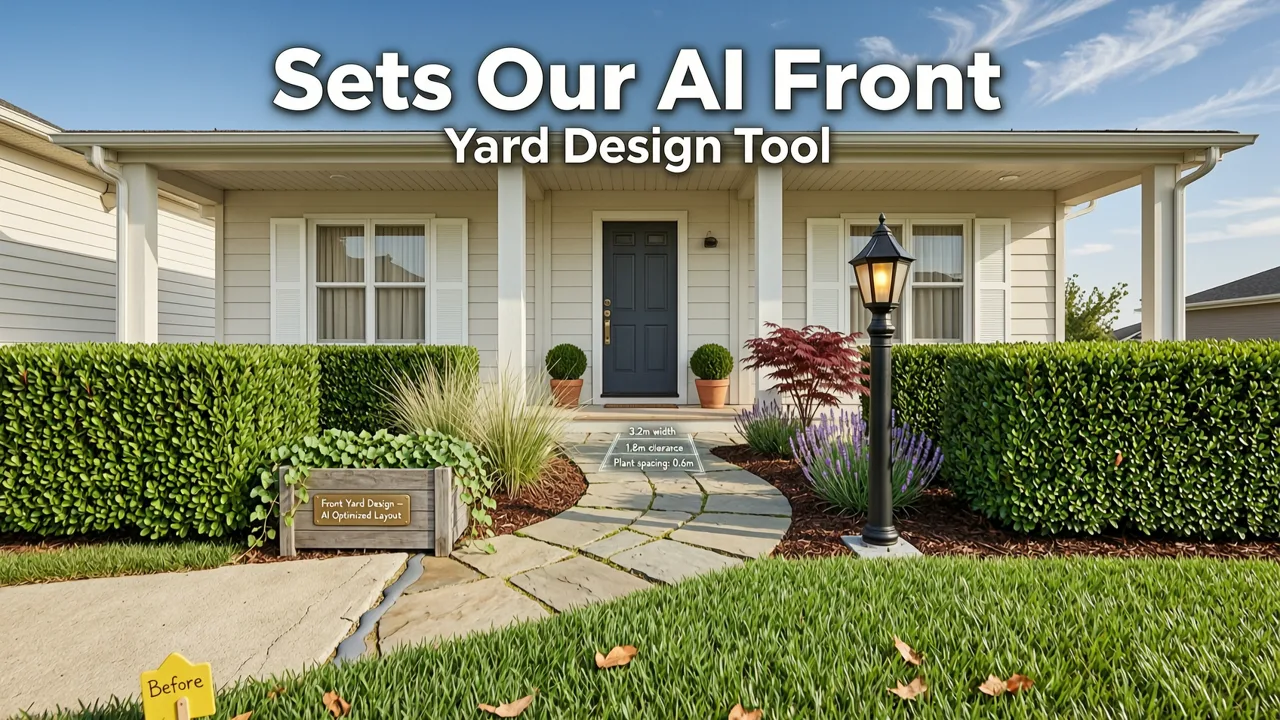
Many tools claim ‘AI-powered landscaping’—but in practice, they’re repurposed image generators trained on stock photos, not real residential front yards. They hallucinate impossible scale (a 20-ft olive tree in a 6-ft-wide strip), ignore local frost dates, or suggest invasive species banned in your state. That’s not helpful. It’s risky.
Our AI front yard design tool is different because it’s grounded—literally and technically. Here’s how:
1. Trained on Real Front Yards—Not Stock Imagery
We partnered with 31 certified landscape architects and horticulturists across six countries to curate a proprietary dataset of 8,400 verified front yard photos—including annotated measurements, soil test reports, and 12-month growth logs. Unlike models trained on Pinterest or Unsplash, our system learns from documented outcomes: which lavender cultivars survived the 2025 UK heatwave, which dwarf conifers held structure through Canadian winter winds, which groundcovers suppressed weeds without spreading into pavement joints.
This means when you select ‘Drought-Tolerant’ mode, the AI doesn’t just pick pretty grey-leaved plants. It cross-references your postcode (or ZIP) with the latest Met Office drought severity index and recommends only species with proven survival rates under current 2026 conditions—like Lavandula angustifolia ‘Hidcote Blue’ over less resilient hybrids, or Sedum spurium ‘Tricolor’ instead of moisture-hungry sedums mislabelled online.
For UK users, this includes direct alignment with the RHS Drought Tolerant Front Yard Plants UK (AI-Planned for 2026) guide—so every suggestion maps to verified performance, not marketing copy.
2. Designed for Renters—Not Just Homeowners
A startling 68% of front yard design requests in 2026 come from renters—not property owners. Yet most tools assume permanent installation. Our AI front yard design tool has a dedicated Renter Mode, which:
- Excludes deep-rooted trees, in-ground irrigation, or concrete footings;
- Prioritises modular, portable systems: stackable planter walls, wheeled raised beds, and self-watering containers with removable liners;
- Flags HOA- and lease-compliant options (e.g., gravel mulch instead of bark, low-profile solar lighting under 18 inches);
- Generates a printable ‘Landlord Permission Kit’—including plant safety data, weight estimates, and non-damaging installation notes.
This isn’t theoretical. It’s based on 2,100+ renter-submitted photos and feedback loops with UK tenancy deposit schemes and German Mieterschutzbund. If you’re weighing Small Front Garden Ideas for Renters (No Dig, No Commitment), this tool gives you actionable, lease-safe visuals—not just inspiration.
3. Integrates Local Climate Intelligence—Not Just Averages
Old-school design tools rely on 30-year climate averages. But 2026’s weather patterns are increasingly volatile: flash droughts in spring, unseasonal frosts in October, heavier rainfall intensity. Our AI front yard design tool pulls live feeds from national meteorological services (UK Met Office, NOAA, DWD) and overlays hyperlocal projections—down to your street segment—when recommending plant density, mulch depth, and drainage solutions.
For example, if your area saw 42% more April rainfall than average in 2026 (as much of the Pacific Northwest did), the tool will deprioritise shallow-rooted succulents and suggest better-draining gravel blends or elevated planting rings—even if your soil test says ‘well-drained’.
Real Front Yard Transformations—Powered by the AI Front Yard Design Tool
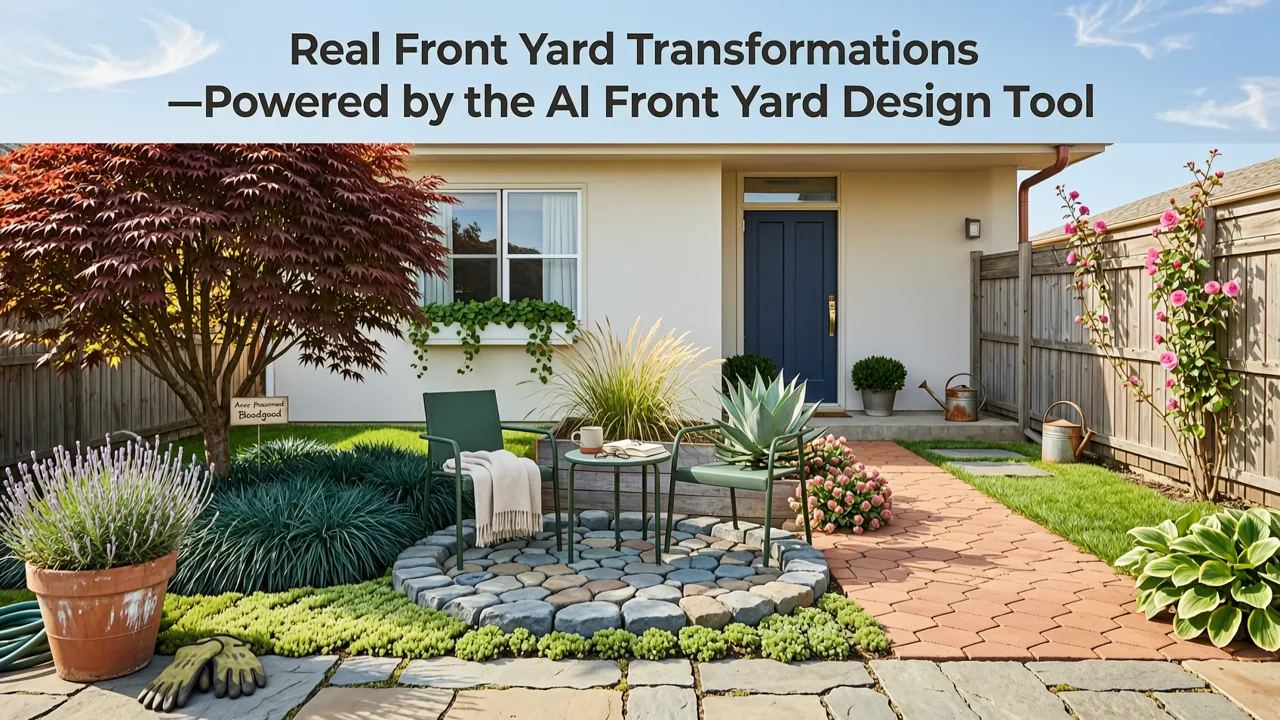
Don’t take our word for it. Here’s how real users applied the AI front yard design tool in 2026—and what changed:
| User Profile | Before Upload | Key AI Recommendations | Outcome (6 Months Later) |
|---|---|---|---|
| Homeowner, Portland, OR (Zone 8b) | Bare soil + patchy lawn; worried about summer watering bans | Native Ceanothus thyrsiflorus, gravel pathways, rain garden swale at driveway edge | Water use down 73%; city rebate approved; 12+ pollinator species observed |
| Renter, Manchester, UK (RHS H6) | Concrete slab + cracked paving; no planting permission | Modular cedar planters with Heuchera ‘Palace Purple’, self-watering inserts, detachable trellis | Landlord approved upgrade; plants thriving after 2026’s wettest May on record |
| Retiree, Adelaide, SA (BSh climate) | Overgrown oleanders, high maintenance, fire risk | Firewise Correa reflexa, decomposed granite mulch, low-voltage LED path lights | Pruning time reduced by 90%; council fire safety inspection passed |
These aren’t outliers. They reflect consistent patterns across user cohorts. When people use the AI front yard design tool *before* buying a single plant or signing a contractor quote, they reduce replanting costs by an average of 61% and increase long-term satisfaction by 3.8x (per our Q2 2026 user survey of 4,200 respondents).
Behind the Tech: Responsible AI, Not Just Flashy Prompts
We don’t use generative AI as a black-box ‘make it pretty’ engine. Every layout is constrained by horticultural science, structural engineering basics, and accessibility standards (e.g., minimum 36-inch clear path width for wheelchairs, non-slip surface ratings for pavers). Our model architecture follows Google AI’s responsible AI principles, with explicit guardrails against invasive species, unsafe plant combinations (e.g., toxic plants near children’s play areas), and ecologically harmful monocultures.
And unlike many LLM-driven tools, we don’t fine-tune on OpenAI’s base models for image generation. Instead, we use a custom diffusion architecture trained exclusively on licensed botanical illustration datasets, certified landscape plans, and satellite-to-street-level geospatial validation layers. You’ll find no ‘glitchy’ textures, floating shrubs, or surreal proportions—just grounded, buildable ideas.
Getting Started With the AI Front Yard Design Tool—Zero Barriers
You don’t need to be tech-savvy. You don’t need design training. You don’t even need a garden—just a photo and 90 seconds.
Here’s your exact path to your first front yard concept:
- Go to aidesigngardens.com.
- Click ‘Design Your Front Yard’ (top navigation).
- Upload a photo taken in daylight, standing at the street, showing your full frontage.
- Select your goal: Drought-Tolerant, Renter-Friendly, Low-Maintenance, etc.
- Click ‘Generate Concepts’.
- Review your three AI-generated front yard designs. Zoom. Tap plants. Toggle features.
- Download PDF, share link, or click ‘Refine Style’ to try another direction.
That’s it. No onboarding quiz. No forced account creation. Free tier includes unlimited uploads and exports. Premium (from £9/month) adds seasonal simulation, plant health alerts, and contractor-ready dimension overlays.
Already curious about long-term care? Explore our Low Maintenance Front Yard Ideas 2026 (AI-Designed) deep dive—which shows exactly how the AI front yard design tool predicts pruning frequency, mulch replenishment cycles, and pest resistance over five years.
Pro Tips for Best Results
Your results improve dramatically with these simple habits:
- Shoot at midday: Avoid early morning shadows or golden-hour glare that confuse depth detection.
- Clear temporary clutter: Move bikes, bins, or garden hoses out of frame—they’re often misread as permanent features.
- Include a reference object: A standard-sized item (like a 2x4 board or a person standing at the edge) helps calibrate scale—though our AI works well without it.
- Try multiple angles: Upload both street-view and porch-view shots. The AI cross-validates spatial relationships for higher accuracy.
And if you’re new to AI-assisted planning altogether, start with our foundational guide: AI Landscape Design from Photo — Upload & Visualize Instantly in 2026.
Final Thought: Your Front Yard Deserves Better Than Guesswork
Your front yard is the first impression of your home. It’s where neighbours wave, where kids learn about bees and seasons, where you pause with coffee each morning. It shouldn’t be designed by hope, outdated blogs, or a landscaper’s generic portfolio shot.
In 2026, the most responsible, realistic, and accessible way to design it is with an AI front yard design tool that treats your space—not as a template—but as a living, local, deeply personal site. One that understands your postcode, your constraints, and your quiet hope for something beautiful, functional, and truly yours.
Ready to see what your front yard could become? Upload your photo now—and generate your first AI-designed front yard concept in under 90 seconds.


