

Backyard Landscape Ideas Before and After: Why Seeing Beats Imagining in 2026
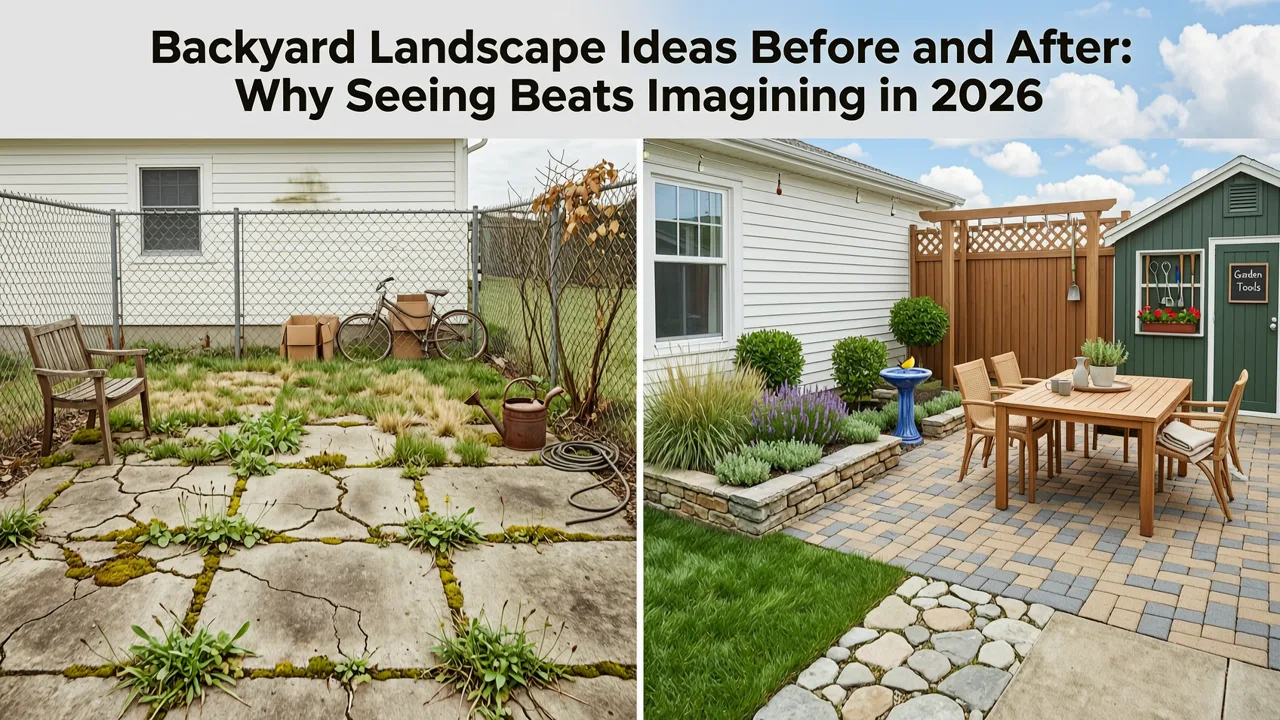
If you've ever stared at a tired, overgrown backyard and couldn't picture what it could become, you know the frustration of backyard landscape ideas before and after content — it's inspiring online, but almost never matches your actual space. The good news: in 2026, AI-powered visualization tools let you generate your own before-and-after transformations using nothing but a smartphone photo.
This guide walks you through real-world backyard transformations, the design principles that drive them, and how modern AI tools like AI Backyard Design Tool – Upload & Visualize Instantly help homeowners preview planting layouts, hardscape upgrades, and outdoor living zones before committing a single dollar to a contractor or nursery.
How Before-and-After Backyard Transformations Actually Work
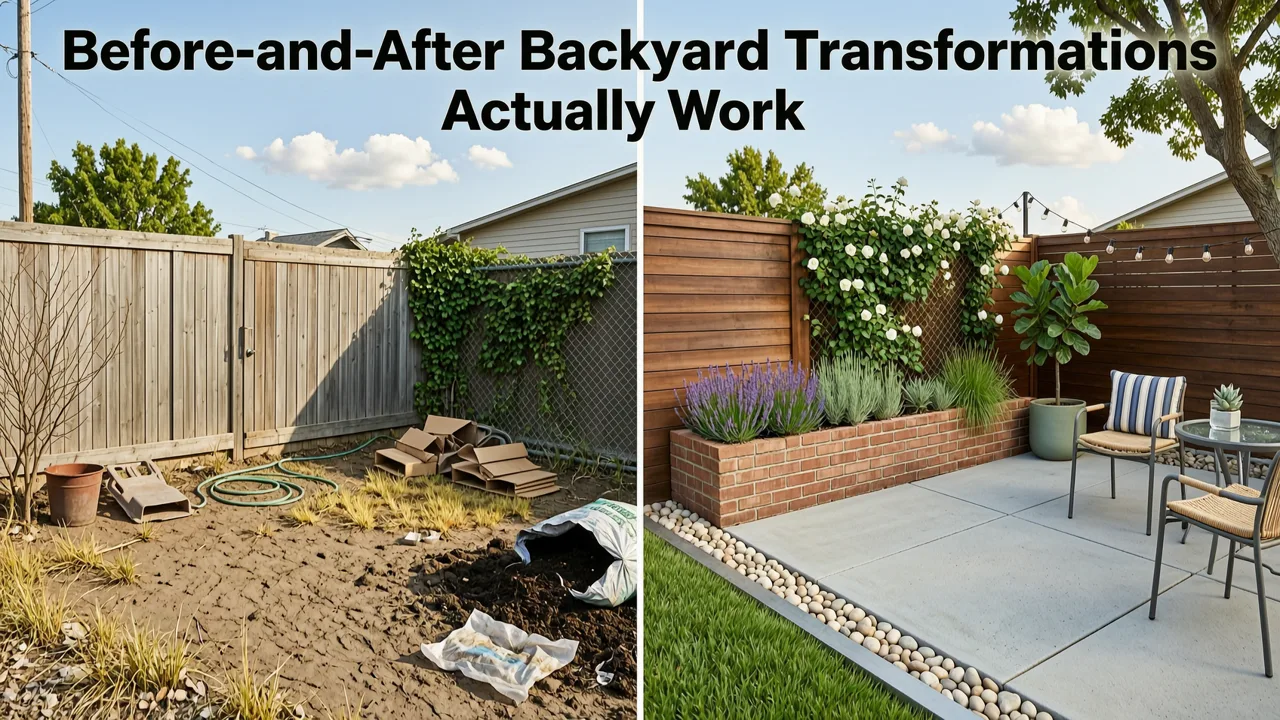
Every successful backyard makeover follows the same invisible sequence: assessment, concept, refinement, and execution. The difference between a stunning transformation and a costly disappointment is whether the homeowner truly visualized the end result before breaking ground.
50 Most Beautiful Backyard Landscaping Ideas To Create Your Own Paradise
by Decor Home Ideas
In the past, that visualization required hiring a landscape architect, waiting weeks for CAD renderings, and hoping the final build matched the drawing. Today, AI-driven design platforms compress that timeline to minutes. You upload a photo, choose a style direction, and the system produces a photorealistic rendering that accounts for your actual fence lines, lighting conditions, and spatial constraints.
The Assessment Phase: Reading Your Space
Before any design happens, you need an honest read on what your yard gives you to work with. Take note of sun exposure patterns, drainage issues, existing structures, and sightlines from indoor living areas. A south-facing yard with compacted clay soil tells a very different design story than a shaded north-facing courtyard with sandy loam.
The Concept Phase: Matching Vision to Reality
This is where most DIY planners stumble. They fall in love with a Pinterest image that assumes a quarter-acre lot, full sun, and a $40,000 budget. AI tools solve this mismatch by anchoring every concept to your photo — so the before-and-after comparison is always grounded in your real geometry.
7 Backyard Landscape Ideas Before and After Transformations to Steal in 2026
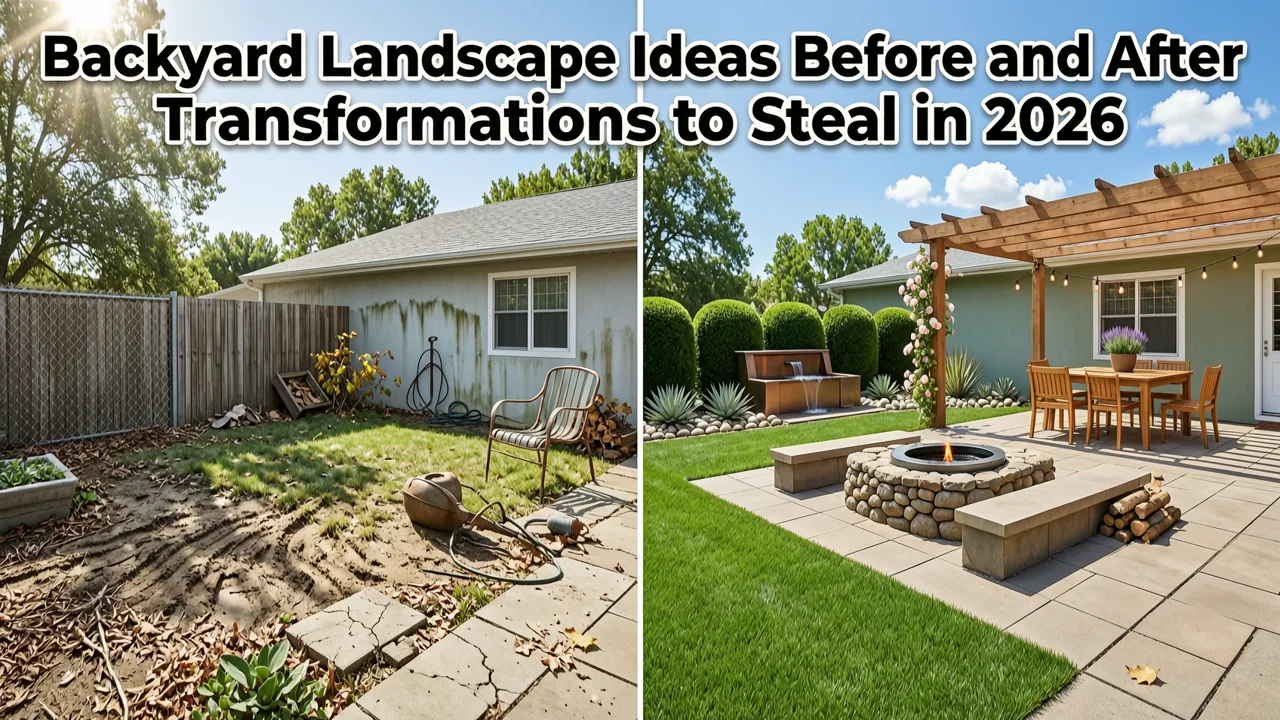
Below are seven transformation archetypes we've seen perform consistently well across climates, lot sizes, and budget ranges. Each one starts with a common problem state and ends with a design direction you can preview using AI visualization before committing.
1. Patchy Lawn to Layered Native Meadow
Before: A thin, weed-invaded lawn with bare spots, compacted soil, and inconsistent irrigation coverage.
After: A flowing native meadow using region-appropriate grasses, wildflowers, and ground covers that require 60–70% less water than traditional turf. Clumping ornamental grasses like Muhlenbergia capillaris define edges, while flowering perennials add seasonal color without the maintenance burden of a formal bed.
This transformation works especially well for homeowners in water-restricted regions who want curb appeal without the irrigation bill.
2. Bare Dirt Side Yard to Functional Outdoor Room
Before: A neglected strip between the house and the fence — too narrow for a traditional garden bed, too visible to ignore.
After: A decomposed granite path flanked by raised cedar planters, a compact bistro table, and a vertical green wall using trailing herbs and ferns. The space becomes a morning coffee nook rather than a guilt zone.
If your side yard feels too tight for conventional ideas, explore Backyard Landscape Ideas for Small Spaces in 2026 for layouts that scale with reality.
3. Cracked Concrete Patio to Multi-Zone Entertaining Deck
Before: A sun-baked, cracked concrete slab with no shade, no defined zones, and drainage pooling toward the foundation.
After: A composite deck with built-in bench seating, a pergola with retractable shade canopy, a fire table conversation zone, and integrated LED step lighting. The concrete is either resurfaced or partially demolished to make room for permeable paver transitions.
Upload your own patio photo to see how this transformation could look in your space using Patio Layout Ideas from Photo — Try AI Design Free in 2026.
4. Overgrown Hedge Border to Structured Privacy Screen
Before: A row of untrimmed privet or Leyland cypress that has grown into a chaotic, light-blocking wall with dead interior branches.
After: A layered privacy screen combining evergreen columnar trees (like Italian cypress or Sky Pencil holly) in front of a slatted wood fence, with understory plantings of shade-tolerant ferns and hostas at the base. The result is privacy without the fortress feeling.
5. Utility-Heavy Backyard to Hidden Storage Garden
Before: Visible AC condenser, utility boxes, hose bibs, and trash can staging area dominating the backyard view from the kitchen window.
After: A lattice screen wall with climbing jasmine or clematis, a latched gate panel for utility access, and a bench-style trash enclosure that doubles as seating. The utilities remain accessible but visually disappear.
6. Flat, Featureless Yard to Graded Terraced Garden
Before: A monotonous flat yard with no visual depth, poor drainage, and no sense of discovery.
After: Two or three gentle terraces connected by stone steps, each planted with a different palette — ornamental grasses on top, flowering shrubs in the middle, and a ground-level patio with container gardens. The grading also solves drainage issues by directing runoff to a dry well or rain garden.
7. Weedy Vacant Lot to Productive Edible Landscape
Before: A backyard dominated by crabgrass, dandelions, and bare patches where previous owners never bothered to landscape.
After: A structured edible landscape featuring raised bed vegetable gardens, a dwarf fruit tree espaliered against the fence, a pollinator-friendly herb spiral, and gravel pathways for clean access. The yard produces food while looking intentionally designed.
Choosing the right plants for your climate and soil is critical at this stage — see Best Plants for My Backyard — AI-Powered Matching in 2026 for guidance on species selection.
How AI Visualization Creates Your Personal Before-and-After
The gap between browsing generic before-and-after galleries and seeing your own yard transformed is the difference between window shopping and test driving. AI-powered design tools in 2026 use spatial analysis, style-conditioned rendering models, and plant compatibility databases to produce concepts that reflect your actual space.
Step 1: Photo Intake and Spatial Understanding
You upload one or more photos of your yard. The system identifies boundaries, existing structures, light conditions, and perspective geometry. Modern models, built on architectures documented in resources like OpenAI documentation, can distinguish between a fence, a wall, a hedge, and a deck from a single image.
Step 2: Style Selection and Concept Generation
Choose a design direction — modern minimalist, cottage garden, desert xeriscape, tropical resort, Japanese zen, or dozens of other style profiles. The AI generates a photorealistic rendering overlaid on your actual photo, preserving your fence lines, house architecture, and tree placement.
Step 3: Iteration and Comparison
Don't like the first concept? Adjust plant density, swap hardscape materials, add or remove features, and generate new variations. This iterative loop is where the real value lives — you can compare three or four design directions side by side before ever calling a contractor.
Responsible AI Use in Landscape Design
AI-generated renderings are planning tools, not construction documents. They help you narrow direction and communicate preferences to professionals, but site-specific factors like soil tests, utility locates, and permitting requirements still require human expertise. Frameworks like Google AI guidance emphasize that AI outputs should be validated against real-world conditions before execution.
Before-and-After Comparison: What Changes and What Stays
One of the most useful exercises in backyard planning is separating what you must change from what you can choose to change. Here's a practical breakdown:
| Element | Typically Fixed | Typically Changeable | AI Preview Value |
|---|---|---|---|
| Property boundaries | Yes | No | High — AI preserves these accurately |
| Mature trees | Usually | Rarely (removal is costly) | High — AI shows designs around existing trees |
| House architecture | Yes | No | High — style must complement existing architecture |
| Lawn area | No | Yes — reduce, replace, or reshape | High — compare turf vs. meadow vs. hardscape |
| Patio or deck | No | Yes — resurface, expand, or relocate | High — preview materials and layout changes |
| Fence style | Sometimes (HOA rules) | Often — material, height, color | Medium — depends on local regulations |
| Plant palette | No | Yes — fully flexible | Very high — AI matches plants to your conditions |
| Drainage patterns | Yes (gravity doesn't change) | Managed, not moved | Low — requires on-site assessment |
Common Mistakes Homeowners Make Without Visual Planning
Skipping the visualization step leads to predictable — and expensive — errors. Here are the most frequent ones we see:
Planting Too Close Together
Nursery pots show plants at their peak density. In the ground, that same spacing creates an overcrowded mess within two seasons. AI renderings use mature plant sizes, so your before-and-after preview reflects how the garden will actually look at year three, not day one.
Ignoring Sightlines
A beautiful backyard means nothing if the best view is blocked by a misplaced shed or an awkwardly positioned tree. AI tools let you evaluate sightlines from your kitchen window, living room, and patio before anything is built.
Mismatched Style and Architecture
A ultra-modern minimalist garden can look jarring against a traditional craftsman home. Seeing the design overlaid on your actual photo catches these clashes immediately, before mulch is delivered and posts are set.
Underestimating Hardscape Costs
Homeowners often budget 80% for plants and 20% for hardscape — then discover that a patio, pergola, and retaining walls consume 70% of the budget. Previewing hardscape options in AI lets you calibrate expectations early and make informed trade-offs.
How to Create Your Own Before-and-After in Under 10 Minutes
The process is straightforward and requires no design experience:
- Take a clear photo of your backyard from the primary viewing angle. Stand near the house and shoot outward — this captures the perspective you experience daily.
- Upload to an AI design tool like AI Garden. The system analyzes your photo's geometry, lighting, and existing features.
- Select a style direction that matches your taste and climate. Browse options like modern, cottage, xeriscape, tropical, or Mediterranean.
- Review the generated concept. The AI produces a photorealistic rendering that preserves your actual structures and boundaries.
- Iterate. Try different styles, swap plant types, adjust hardscape materials, and compare side by side.
- Share with a contractor or use as a DIY roadmap. Your before-and-after comparison now communicates your vision precisely.
What Makes 2026 Different for Backyard Planning
Three shifts have changed how homeowners approach landscape design this year:
Rendering quality has crossed the realism threshold. AI-generated landscape images are now visually indistinguishable from professional 3D renderings for planning purposes. You're no longer looking at rough approximations — you're seeing plausible, detailed previews.
Plant databases are climate-aware. Modern tools cross-reference your photo's inferred conditions (sun exposure, region, shade patterns) with horticultural databases to suggest species that will actually thrive in your yard — not just look good in a rendering.
Iteration is instant. The old workflow — sketch, wait, revise, wait again — has collapsed into a real-time loop. You can explore five design directions in the time it used to take to schedule one consultation.
Frequently Asked Questions
Can AI backyard design tools work with any photo?
Yes, as long as the photo is reasonably clear and shows the yard from a standard perspective. Avoid extreme wide-angle distortion or heavy shadows. A single photo from your back door outward is usually sufficient to generate a useful concept.
How accurate are AI-generated before-and-after renderings?
In 2026, AI renderings are highly accurate for spatial layout, plant placement, and material visualization. They are planning tools, not engineering documents — you still need professional input for structural work, drainage design, and permitting.
Do I need design experience to use AI landscape tools?
No. These tools are built for homeowners, not designers. You choose a style, review the output, and iterate based on what you like. The AI handles proportion, plant compatibility, and spatial balance.
Can I use the AI output to brief a landscaping contractor?
Absolutely. AI-generated before-and-after images are increasingly used as communication tools between homeowners and contractors. They convey your vision far more effectively than magazine clippings or verbal descriptions.
Start Your Transformation Today
The gap between your current backyard and the outdoor space you've been dreaming about is smaller than you think — and shorter than it was even a year ago. With AI-powered visualization, you can explore backyard landscape ideas before and after using your own photo, compare multiple design directions, and walk into any contractor meeting with a clear, realistic vision of what you want.
Upload your backyard photo now and see what's possible. Your before-and-after story starts with a single picture.


