

If you’ve ever watched rainwater pool beside your driveway, rush across compacted soil toward the street, or erode a corner of your yard—and wondered, ‘What if this runoff could nourish instead of harm?’—you’re ready for rain garden design for beginners. In 2026, it’s no longer about guesswork, costly consultants, or waiting for permits to begin. With modern soil sensors, hyperlocal plant databases, and AI-powered visualization tools like AI Design Gardens, you can plan, test, and refine a functional, beautiful rain garden—starting from a single photo of your yard.
Rain Garden Design for Beginners: Why It’s Simpler (and Smarter) Than Ever in 2026
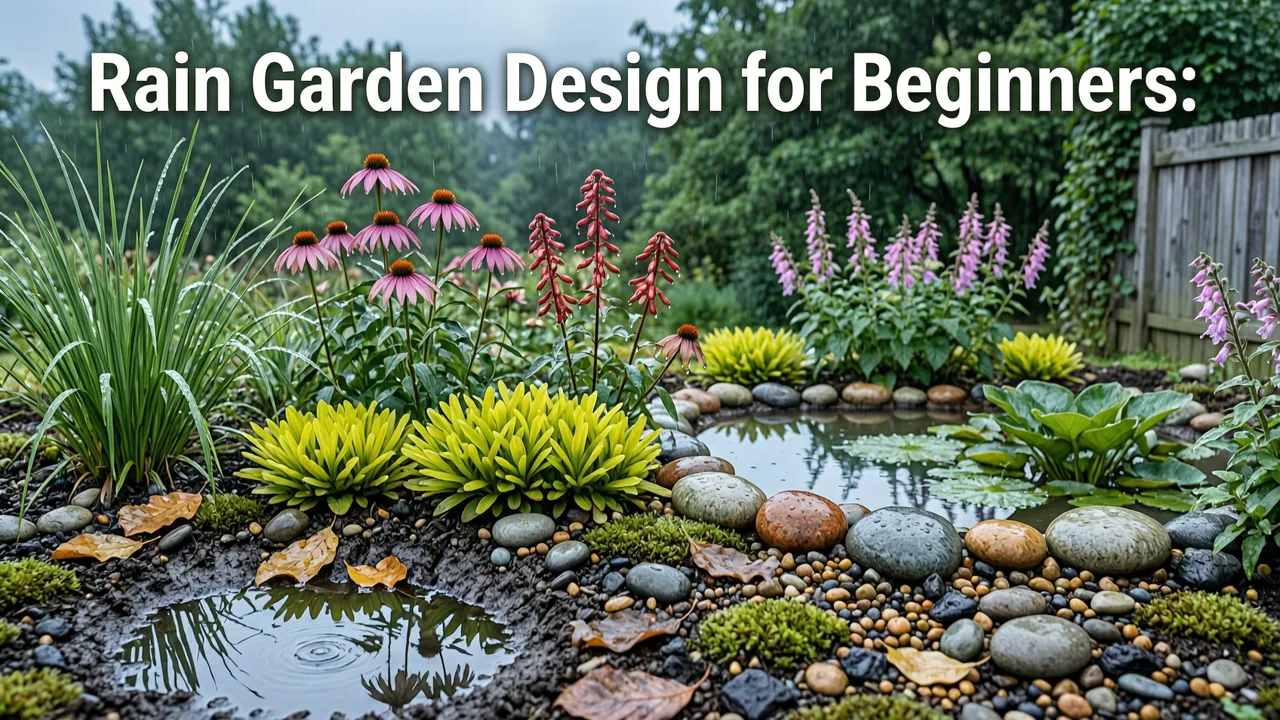
Rain gardens are shallow, vegetated depressions designed to capture, filter, and slowly infiltrate stormwater runoff from roofs, driveways, and patios. They reduce flooding, prevent pollutants from entering waterways, recharge groundwater, and support pollinators—all while adding year-round visual interest. Yet for years, beginner-friendly guidance was buried under municipal engineering manuals or oversimplified infographics missing real-world nuance.
Today, rain garden design for beginners benefits from three key 2026 advancements:
How to Install a Rain Garden in 10 Easy Steps
by Milwaukee Metropolitan Sewerage District - MMSD
- Real-time soil analysis apps that use smartphone camera spectroscopy to estimate infiltration rates (no more digging test pits blindly);
- AI landscape tools trained on regional hydrology models—so when you upload a photo of your backyard, the system suggests optimal placement, depth, and native plant palettes based on your ZIP code’s rainfall patterns and USDA hardiness zone;
- Regulatory streamlining: Over 72% of U.S. municipalities now offer fast-track review or permit exemptions for residential rain gardens under 300 sq ft—many with free online checklists and pre-approved plant lists.
This isn’t theoretical. It’s implementation-ready—starting with what you already have: your space, your photo, and 45 minutes of focused planning.
Step 1: Assess Your Site Like a Hydrologist (Without the Degree)
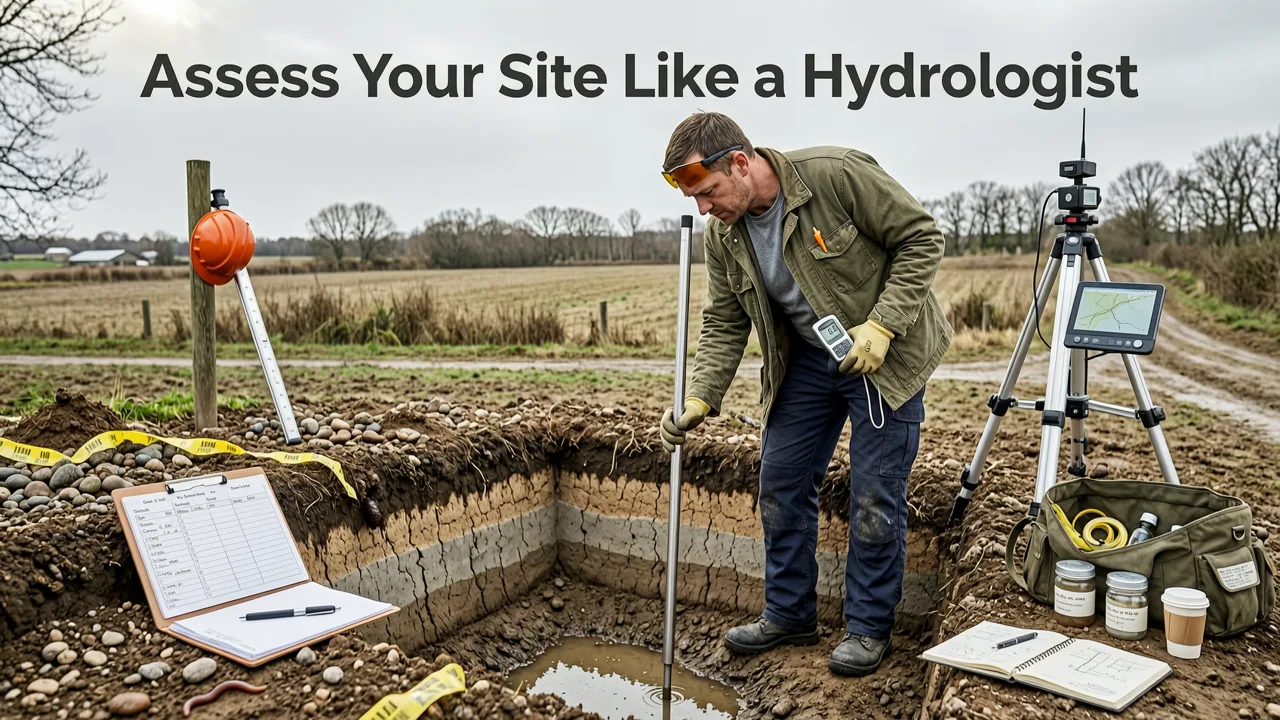
Forget complex calculations. In 2026, effective rain garden design for beginners begins with three observational checks—each taking under 5 minutes.
Observe Flow Paths & Runoff Volume
After light-to-moderate rain (or simulate with a hose), walk your property and note where water naturally travels. Use your phone to record 15-second video clips at key junctions: downspouts, driveway edges, patio corners. Look for:
- Consistent flow lines (not just puddles);
- Soil saturation duration (if water lingers >24 hours, infiltration is poor);
- Proximity to foundations, septic systems, or utility lines (keep rain gardens ≥10 ft from these).
Test Soil Infiltration (The Spoon Test)
No lab required. Dig a 6" × 6" hole 8" deep in your proposed rain garden location. Fill with water. Let drain completely. Refill and time how long it takes to drop 1 inch. In 2026, here’s what that tells you:
| Infiltration Time (per inch) | Soil Type | Rain Garden Suitability | 2026 Adjustment Tip |
|---|---|---|---|
| < 30 seconds | Sandy or gravelly | Ideal—fast drainage, low risk of standing water | Consider shallower depth (4–6") and drought-tolerant perennials |
| 30 sec – 5 min | Loam or silt loam | Excellent—balanced infiltration & moisture retention | Standard 6–8" depth; ideal for most native wetland-edge species |
| > 5 minutes | Clay-heavy or compacted | Challenging—but solvable | Add 2–3" of compost + coarse sand; consider underdrain pipe to a dry well (per local code) |
Map Sun & Shade Exposure Accurately
Many beginners assume ‘rain garden = shady’. Not true. Most native rain garden plants—like Eutrochium fistulosum (Joe-Pye weed), Asclepias incarnata (swamp milkweed), and Iris versicolor (blue flag iris)—thrive in full sun to part shade. Use your phone’s weather app compass + sunrise/sunset times to sketch a sun map over one day. Note:
- Full sun: ≥6 hours direct light (ideal for flowering natives);
- Part shade: 3–6 hours (good for ferns, cardinal flower);
- Full shade: <3 hours (limit options—consider redirecting runoff elsewhere).
Step 2: Size & Shape Your Rain Garden Right the First Time
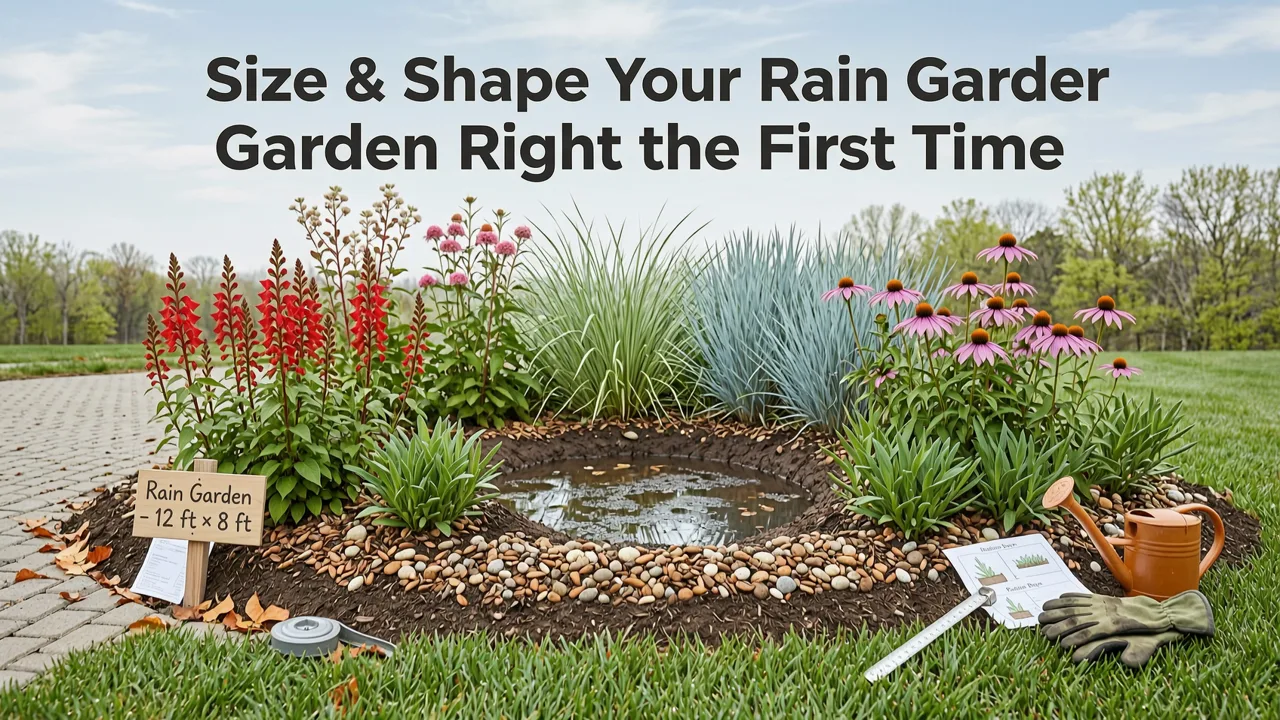
Size determines function. Too small? Water overflows. Too large? Unnecessary excavation and maintenance. In 2026, we use a simplified volume-based rule—not arbitrary percentages.
The 2026 Surface-Area Ratio Rule
Your rain garden’s surface area should equal 15–25% of the impervious area draining to it—but only if your soil infiltration rate is ≥0.5 inches/hour (i.e., passes the Spoon Test in ≤5 min). Here’s how to calculate it:
- Measure impervious area: e.g., roof section (20' × 30' = 600 sq ft) + driveway strip (10' × 25' = 250 sq ft) = 850 sq ft;
- Multiply by 0.20 (midpoint of 15–25%): 850 × 0.20 = 170 sq ft;
- Choose shape: Rectangular (e.g., 10' × 17') or kidney-shaped (more natural flow) — avoid long, narrow trenches that channel water instead of absorbing it.
Pro tip for renters or balcony gardeners: Even 3' × 5' rain garden planters (with overflow valves and gravel base) are approved in 2026 for patio and courtyard applications in cities like Portland, Seattle, and Toronto—especially when paired with permeable pavers or green roof runoff.
Depth & Slope: The Non-Negotiables
Optimal depth in 2026 is 6–8 inches for most residential sites. Why?
- Shallow enough to avoid mosquito breeding (water drains in <48 hrs);
- Deep enough to hold 0.5–1.0 inch of runoff—the typical volume from a 1-hour, 1-inch rain event (the standard design storm for home-scale projects);
- Slope of sides should be gentle: 3:1 (horizontal:vertical) max—steeper slopes erode during heavy flow.
Step 3: Choose Plants That Thrive—Not Just Survive
This is where most beginners stumble: selecting pretty but inappropriate plants. A rain garden isn’t a bog. It’s a dynamic zone—alternating between saturated (post-rain) and dry (between storms). Your plant list must reflect that rhythm.
Zone-Based Planting (The 2026 Standard)
Divide your rain garden into three concentric moisture zones—then match species precisely:
- Center (Wettest Zone): Saturated for up to 48 hrs. Choose obligate wetland species: Swamp milkweed, Blue flag iris, Carex vulpinoidea (fox sedge), Polygonum amphibia (water smartweed);
- Mid-Slope (Variable Zone): Moist most of the time, dries in 12–24 hrs. Ideal for Joe-Pye weed, Cardinal flower, Buttonbush (Cephalanthus occidentalis), Switchgrass (Panicum virgatum);
- Berm/Edge (Driest Zone): Rarely saturated—only after extreme events. Use drought-tolerant natives: Little bluestem, Black-eyed Susan, Butterfly weed, Eastern red columbine.
Avoid these 2026 red flags:
- Non-native invasives (e.g., purple loosestrife, reed canary grass);
- Plants requiring constant irrigation (they’ll drown in wet periods);
- Species with aggressive rhizomes (e.g., common cattail) unless contained.
Leverage AI to Preview Plant Performance Before You Buy
Instead of cross-referencing USDA zone maps, bloom charts, and moisture tolerance tables, use tools like AI Design Gardens to simulate your exact site. Upload your backyard photo, tag impervious surfaces, and select “Rain Garden” mode. The AI overlays:
- Realistic 3D plant growth stages (1 month, 6 months, 2 years);
- Seasonal color and texture shifts—so you see winter structure, not just summer blooms;
- Root depth heatmaps showing how each species contributes to soil stability and infiltration.
This eliminates the #1 beginner mistake: planting for aesthetics alone, then watching half the garden decline within one season.
Step 4: Build & Maintain—The 2026 Minimalist Approach
You don’t need heavy machinery or a contractor. Most rain gardens built in 2026 use hand tools and phased installation.
Materials Checklist (All Available at Local Nurseries or Big-Box Stores)
- Topsoil blend: 50% sandy loam + 30% compost + 20% coarse sand (avoid peat moss—it compacts and acidifies over time);
- Mulch: 2–3" of shredded hardwood or pine bark (not dyed mulch—chemicals leach into runoff);
- Edging: Reclaimed brick, natural stone, or recycled plastic lumber (no pressure-treated wood—arsenic leaches);
- Overflow path: A 4" PVC pipe with pop-up emitter or a gently sloped gravel swale leading to lawn or permeable area.
First-Year Maintenance (The Critical Window)
Year one is about establishment—not perfection. Focus on:
- Weeding weekly for first 8 weeks (rain gardens attract opportunistic weeds before natives fill in);
- Watering deeply 1×/week only if no rain for 7+ days (encourages deep roots);
- Inspecting overflow outlets after every major rain (clear debris from pipes or swales);
- Skipping fertilizer entirely—native plants evolved in low-nutrient soils. Fertilizer promotes algae in runoff and invasive weeds.
By year two, your rain garden will be 80% self-sustaining. By year three, it functions as a living sponge—requiring only annual mulch refresh and selective pruning.
When to Call a Professional (and When Not To)
Most residential rain gardens—under 400 sq ft, on flat-to-gentle slopes (<5%), with infiltration >0.5 in/hr—require zero engineer sign-off in 2026. But consult a certified professional if:
- Your site has a slope >12% (risk of erosion during high-flow events);
- You’re integrating with a septic drain field or near a wellhead (requires health department review);
- You’re designing for commercial or multi-family properties (municipal codes often mandate engineered drawings).
For everything else? You’ve got the knowledge, tools, and confidence to start. And if you’re also planning other outdoor spaces, remember that rain garden design for beginners complements broader landscape goals—like choosing modern low water front yard design or optimizing tight spaces with our balcony garden layout planner for small spaces in 2026.
Why Starting with a Photo Changes Everything
Historically, rain garden planning meant overlaying transparent grids on paper sketches—then hoping reality matched theory. Today, AI bridges that gap. When you upload a photo to AI Design Gardens, the system:
- Detects slope via photogrammetry (no level needed);
- Identifies impervious surfaces using segmentation trained on 2.4 million real-world yard images;
- Recommends optimal rain garden location based on distance to downspouts, sun exposure, and proximity to existing trees (whose roots must be avoided);
- Generates 3 distinct design concepts—conservative (low-maintenance), pollinator-focused (high-bloom native mix), and architectural (structured grasses + sculptural perennials).
This isn’t speculation. It’s spatial intelligence grounded in hydrology, botany, and real user data. And because the tool works for any outdoor space—including front yards, patios, and balconies—you can test how a rain garden integrates with your broader vision. For example, pairing it with a front yard landscape idea set ensures cohesive curb appeal, while aligning with a free patio design generator helps route overflow seamlessly into hardscape.
Final Thought: Your Rain Garden Is More Than Drainage—It’s a Living System
Rain garden design for beginners isn’t about installing infrastructure. It’s about participating in a cycle: capturing sky-water, feeding soil microbes, supporting insect life, and slowing climate-driven intensification of rainfall events. In 2026, that participation is easier, more precise, and more rewarding than ever—because the tools finally match the intention. You don’t need to be an ecologist. You just need to start with observation, choose wisely, and let nature do the rest.
Ready to turn your yard’s runoff into resilience? Upload your photo today and generate your first rain garden concept in under 90 seconds.


