

Modern Japanese Garden Layout Ideas for 2026
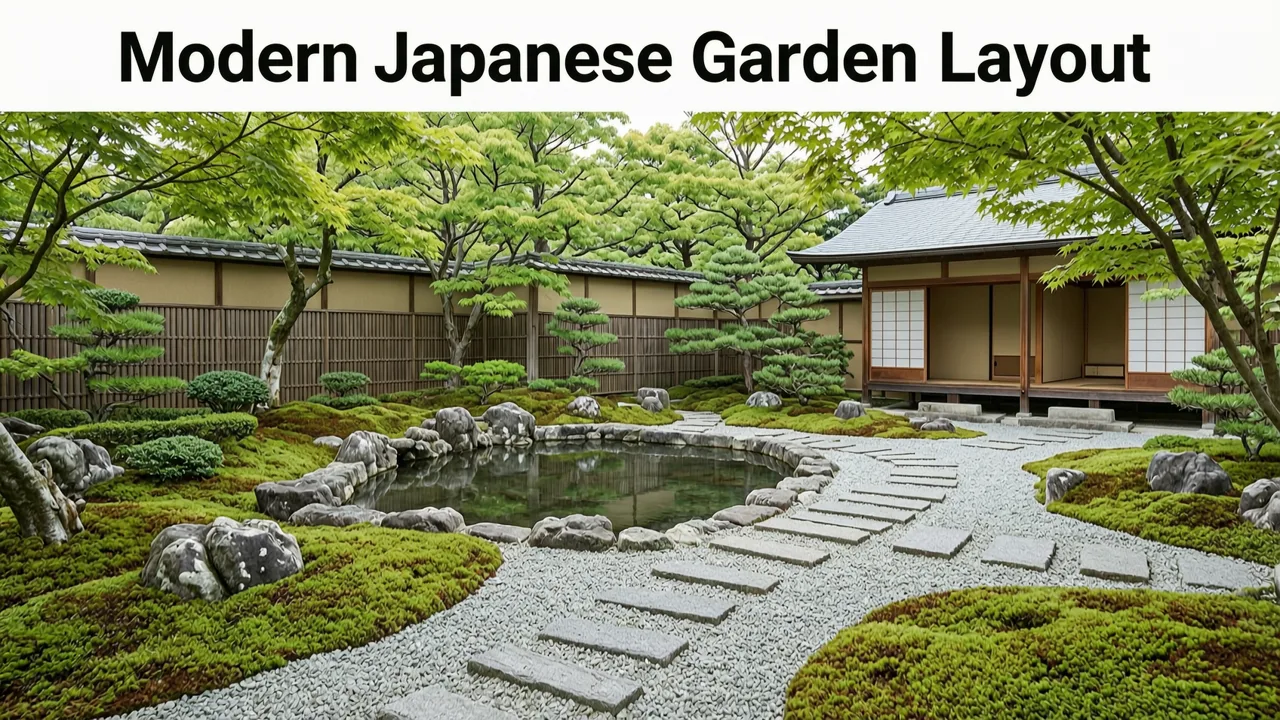
If you have ever walked through a Japanese garden and felt an immediate sense of calm, you already understand why this style continues to dominate landscape design conversations in 2026. A modern Japanese garden layout blends centuries-old principles with contemporary minimalism, clean geometry, and climate-adapted plant palettes that work in backyards, front yards, and even balconies around the world.
The short answer: a modern Japanese garden layout prioritizes asymmetrical balance, negative space, natural materials, and a restrained plant palette, arranged around one or more focal points such as a stone lantern, water basin, or sculptural maple. In 2026, homeowners are using AI-powered design tools to visualize these layouts on their own property before spending a single dollar on materials or plants.
This guide breaks down the essential elements, spatial rules, plant selections, and hardscape decisions that define a credible modern Japanese garden. It also shows you how to test a layout against your real outdoor space using a photo—so you can compare directions and avoid expensive planting mistakes.
Japanese Garden Builds: 14 Breathtaking Before & After Makeovers
by Sakura & Stone
Why Modern Japanese Garden Design Is Trending in 2026
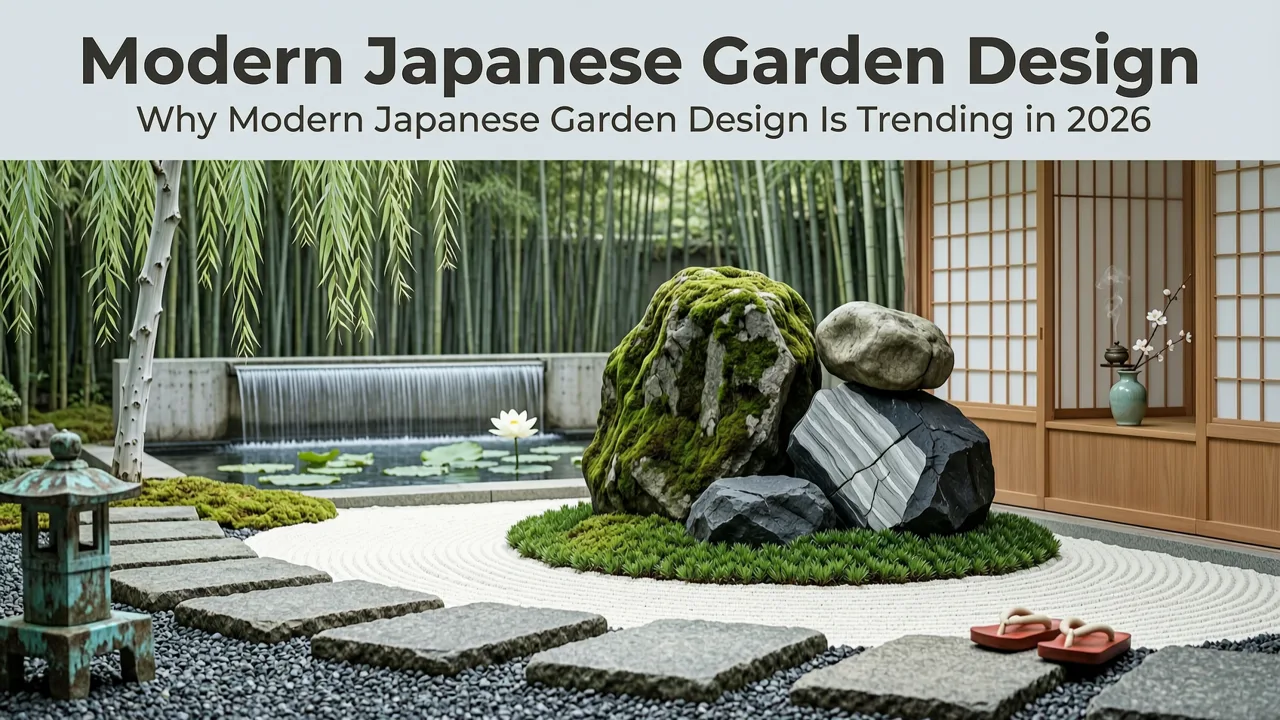
Japanese garden aesthetics have always attracted homeowners who value intentionality over ornament. But in 2026, three converging trends have pushed the style further into the mainstream:
- Climate resilience. Drought-tolerant grasses, moss alternatives, and gravel-based ground covers align with both Japanese dry garden traditions and modern water-wise landscaping mandates.
- Outdoor living as primary space. Homeowners are treating patios and side yards as extensions of their interior design, and the Japanese emphasis on material honesty and spatial flow translates naturally to that mindset.
- AI visualization tools. Platforms like AI garden design apps now let you upload a photo of your yard and generate a realistic modern Japanese garden layout in under two minutes, removing the guesswork that used to require a landscape architect consultation.
The result is a garden style that feels both timeless and urgently relevant. It answers the desire for calm, order, and low maintenance without sacrificing visual depth.
Core Principles Behind Every Modern Japanese Garden Layout
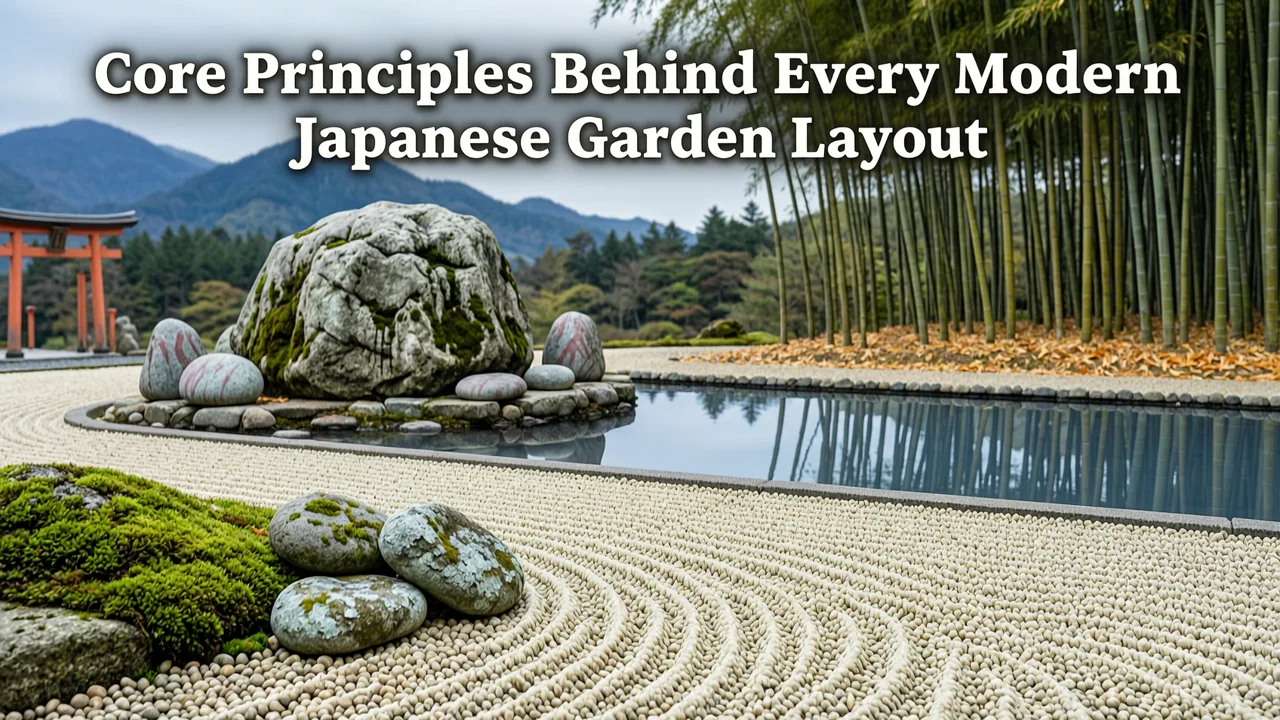
Before choosing plants or ordering gravel, it helps to understand the philosophical framework. A modern Japanese garden layout is not simply a collection of objects placed in a yard. It is a composed experience governed by a handful of non-negotiable principles.
Asymmetry and Natural Irregularity
Symmetry signals human control. Japanese gardens signal nature's own order. Elements are grouped in odd numbers—three, five, seven—and placed off-center to create visual tension that invites the eye to wander.
Ma (Negative Space)
Ma is the Japanese concept of meaningful emptiness. In a modern Japanese garden layout, open gravel, raked sand, or a simple moss carpet is not wasted space. It is the breathing room that gives every stone, plant, and structure its weight.
Wabi-Sabi and Material Honesty
Materials should look like themselves. Weathered wood, raw stone, oxidized steel, and unglazed ceramic are preferred over polished or painted finishes. In a modern interpretation, this extends to concrete planters with board-formed textures and Corten steel edging.
Borrowed Scenery (Shakkei)
If your property has a view of a distant tree line, mountain, or even a neighbor's well-maintained hedge, a modern Japanese garden layout can incorporate that backdrop as part of the composition. The garden does not end at your fence line.
Layered Depth (Miegakure)
Hide-and-reveal sequencing keeps the garden interesting from every angle. A bamboo screen, a curved path, or a strategically placed stone can partially obscure a focal point, encouraging exploration.
Essential Elements of a Modern Japanese Garden Layout
Every credible layout includes a subset of the following elements. You do not need all of them—in fact, restraint is the point—but each one you include should earn its place.
| Element | Traditional Role | Modern Interpretation |
|---|---|---|
| Water (real or implied) | Purity, reflection, life | Raked gravel "streams," recirculating basins, or linear water channels |
| Stone (ishi) | Mountains, permanence, anchoring | Single sculptural boulders, stepped paths, or stacked slab features |
| Plants (shokubutsu) | Seasonal change, symbolism | Restrictive palette: maples, pines, mosses, ornamental grasses |
| Bridge or path (hashi/michi) | Transition, journey | Flush-set stone steps, floating timber decks, or gravel paths with edging |
| Enclosure (kakoi) | Separation from the everyday | Bamboo fencing, living walls, horizontal slat screens |
| Accent (ten) — lantern, basin, sculpture | Focal point, spiritual marker | Minimalist concrete lantern, single Corten steel sculpture, or a lone bonsai |
Step-by-Step: Planning Your Modern Japanese Garden Layout
Here is a practical workflow for translating these principles into a plan you can actually build—or at least visualize before committing.
Step 1: Survey Your Space Honestly
Measure the area. Note sun exposure, drainage patterns, existing structures, and sightlines from the house. A modern Japanese garden layout works best when it can be viewed from at least one primary vantage point—a kitchen window, a patio seating area, or an entry path.
Step 2: Choose Your Focal Point First
Pick one element that anchors the design. It might be a specimen Japanese maple, a recirculating stone basin, or a single large boulder. Everything else in the layout should support or frame that focal point, never compete with it.
Step 3: Define the Ground Plane
Decide whether your primary ground cover will be raked gravel, moss (or a moss alternative like Soleirolia soleirolii), low-growing ornamental grasses, or a combination. The ground plane sets the tonal baseline for the entire garden.
Step 4: Layer Plants by Height and Texture
Work in three tiers: a canopy or vertical accent (a maple, a pine, or a tall bamboo screen), a mid-layer of structural shrubs (azaleas, camellias, or clipped boxwood), and a ground layer of mosses, ferns, or sedges. Avoid mixing more than six to eight plant species in a small garden.
Step 5: Add Hardscape and Accents Last
Stone steps, edging, lighting, and accent objects should be placed after the planting structure is resolved. In a modern Japanese garden layout, less hardware is almost always more.
Step 6: Visualize Before You Build
Upload a photo of your actual yard to an AI design tool. If you are working on a front yard, explore front yard landscape ideas you can generate from a photo to see how Japanese-inspired elements integrate with curb appeal. For patio-centric designs, the free AI patio layout generator lets you test gravel patterns, stepping stones, and container placements in seconds.
Plant Palette for a Modern Japanese Garden in 2026
The plant list below reflects what actually performs well in a modern Japanese garden layout across a range of climate zones, with an emphasis on drought tolerance and low maintenance—two priorities that have only grown in importance by 2026.
Trees and Vertical Accents
- Japanese maple (Acer palmatum) — the undisputed centerpiece. Choose dissectum varieties for weeping form or upright cultivars for architectural branching.
- Japanese black pine (Pinus thunbergii) — for cloud-pruned specimens or wind-resistant screening.
- Clumping bamboo (Fargesia spp.) — non-invasive, upright, and ideal for living screens.
- Mugo pine (Pinus mugo) — compact, slow-growing, excellent for smaller gardens.
Shrubs and Structural Mid-Layer
- Satsuki azalea (Rhododendron indicum) — clipped into soft mounds, flowering in late spring.
- Camellia (Camellia japonica) — glossy evergreen leaves, winter blooms in mild climates.
- Pittosporum — an underused evergreen that takes clipping beautifully and tolerates drought.
Ground Covers and Grasses
- Mondo grass (Ophiopogon japonicus) — the classic dark ground cover, especially Nigrascens.
- Japanese forest grass (Hakonechloa macra) — cascading golden-green foliage for shade.
- Moss alternatives — in dry climates, use Dichondra repens, Soleirolia, or fine-textured gravel as a visual substitute.
Hardscape and Material Choices
The materials you select will either reinforce the calm, intentional atmosphere of a modern Japanese garden layout or undermine it. Stick to the following guidelines:
- Stone. Use local stone where possible. A single large boulder is more effective than a dozen small ones. For paths, use irregular flagstone set flush with gravel joints.
- Gravel. Choose a single size and color. Raked gravel in a karesansui (dry landscape) style is the most iconic expression, but even a simple gravel border around a planting bed reads as Japanese-inspired.
- Timber. Untreated cedar, charred shou sugi ban, or naturally weathered hardwood. Avoid glossy finishes.
- Steel. Corten steel edging, planters, or screens add a contemporary edge while maintaining the warm, oxidized palette that complements natural materials.
- Water features. A simple stone basin (tsukubai) with a bamboo ladle is more authentic than a large ornamental fountain. In modern interpretations, a narrow linear channel with recirculating water reads as both Japanese and contemporary.
Common Mistakes That Break the Aesthetic
Even well-intentioned homeowners stumble on a few recurring errors. Avoiding these will keep your modern Japanese garden layout credible and cohesive.
- Too many focal points. One anchor element per viewing zone is the rule. If you have three boulders of equal size competing for attention, the eye has nowhere to rest.
- Overplanting. A Japanese garden is defined as much by what is absent as by what is present. Resist the urge to fill every gap.
- Mixing ornamental styles. Bright annual flower beds, plastic gazing balls, and whimsical lawn ornaments clash with the restrained Japanese aesthetic.
- Ignoring the ground plane. A lawn surrounded by mulch rings is not a Japanese garden. Commit to a unified ground treatment—gravel, moss, or a single ground cover species.
- Skipping the visualization step. In 2026, there is no excuse for guessing. Use an AI tool to generate your front yard landscape ideas or backyard concepts from a real photo before purchasing a single plant.
Sizing Your Modern Japanese Garden Layout
One of the most appealing aspects of this style is its scalability. A modern Japanese garden layout works at virtually every size.
| Space Size | Recommended Approach | Key Elements to Include |
|---|---|---|
| Balcony or small patio (under 50 sq ft) | Container-based zen garden | Single maple in a large planter, gravel tray, one accent stone |
| Side yard or courtyard (50–200 sq ft) | Tsubo-niwa (courtyard garden) | Stepping stone path, one focal tree, moss or mondo grass ground cover, bamboo screen |
| Standard backyard (200–1,000 sq ft) | Full composition with multiple zones | Karesansui gravel area, seating platform, water basin, layered planting beds |
| Large property (1,000+ sq ft) | Promenade garden (kaiyu-shiki) | Winding path, borrowed scenery, multiple reveal points, pond or stream |
Lighting a Modern Japanese Garden for Evening Use
Lighting is where many homeowners overreach. The goal is subtlety, not illumination. Follow these rules:
- Use warm-white LEDs (2700K or lower).
- Place fixtures low—to illuminate the base of a tree, the surface of gravel, or the texture of a stone wall.
- Avoid uplighting large trees unless the specimen is truly exceptional. In most cases, soft downlighting or side-lighting reads as more refined.
- A single illuminated tsukubai or stone lantern can serve as the only accent light in a small garden.
Maintenance Reality Check
A modern Japanese garden layout is lower maintenance than a traditional lawn-and-border garden, but it is not zero maintenance. Expect to budget time for:
- Raking gravel surfaces every few weeks.
- Pruning maples and pines once or twice per year—structural pruning is essential to maintain the intended form.
- Removing leaf litter from moss or gravel areas.
- Replenishing gravel or mulch annually.
If you are unwilling to perform these tasks, consider a gravel-dominant design with minimal planting, which reduces maintenance substantially while preserving the aesthetic.
Visualizing Your Layout with AI Before You Commit
The single most valuable step you can take in 2026 is to see your modern Japanese garden layout rendered against your actual space before breaking ground. AI-powered design tools have matured to the point where they understand spatial relationships, plant proportions, and material textures well enough to produce genuinely useful previews.
The process is straightforward: upload a photo of your yard, select a Japanese-inspired style, and the tool generates multiple layout variations. You can compare a gravel-dominant karesansui approach against a lush, moss-and-maple courtyard garden in the same session. This is the kind of iterative design process that used to require thousands of dollars in professional landscape architecture fees.
Whether you are rethinking your backyard from a photo or refining a front entry, visualization removes the largest source of landscaping regret: committing to a direction you cannot undo once plants are in the ground.
Final Thoughts on Building a Modern Japanese Garden Layout
A modern Japanese garden layout is an exercise in restraint, intention, and respect for natural materials. It rewards homeowners who are willing to subtract rather than add, to wait for a maple to mature rather than fill space with fast-growing filler, and to let gravel and stone do the work that color and ornament do in other styles.
In 2026, the tools available to plan and visualize these gardens have never been better. Use them. Test your ideas against your real space. And remember: the most powerful element in any Japanese garden is the empty space you choose to leave alone.
Ready to see what a modern Japanese garden layout looks like in your own yard? Upload a photo today and generate your first design in under two minutes.


